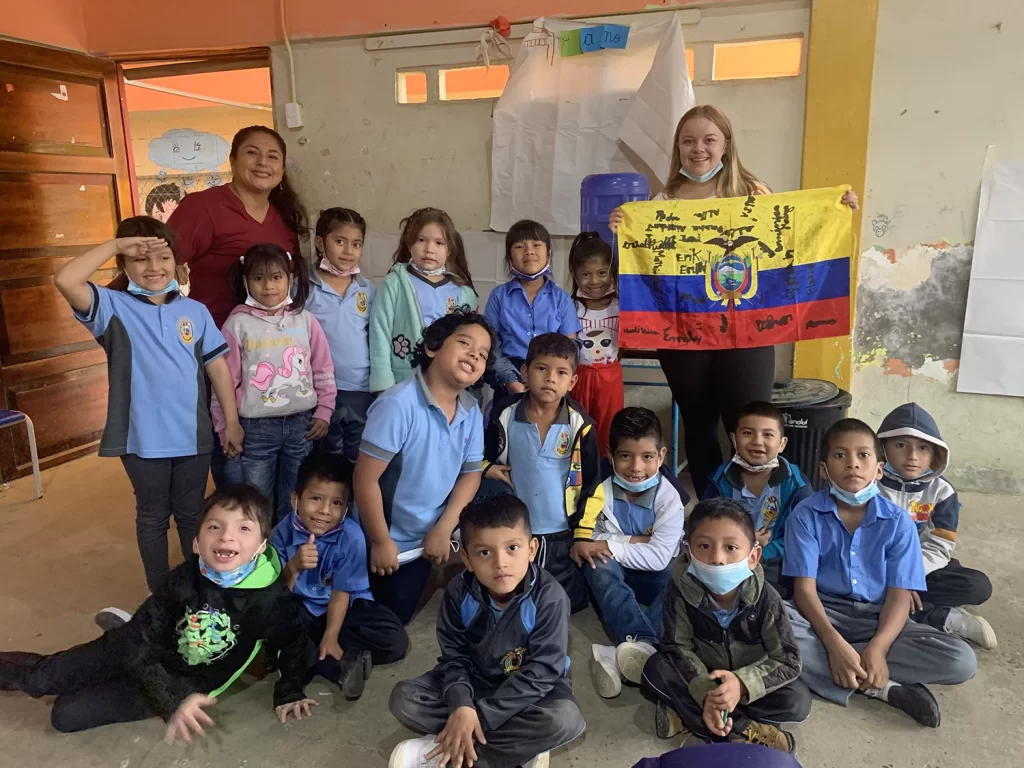
This past summer, I was challenged like I had never been challenged before. I spent the month of July in Puerto López, Ecuador, teaching students from 4K to fourth grade the English language. It was an experience that stretched my worldview, helped me gain independence, and taught me how to best adapt my teaching style to students from different backgrounds.
When I arrived in Puerto López, I was guided through the town by my host mom, Elsa, and let all the cultural differences soak into me like rain that drizzled and poured at different times of the day. The streets were packed and music blared from speakers in everyone’s yards, old salsa music being a common choice. The smell of encebollado, a soup made of fish, lemon juice, onions, and other vegetables, wafted through the humid air. The people I met were very friendly and would all greet me in turn when I met them with an “hola”; however, I found it hard to converse with them. Not because of the language barrier, which I felt I conquered well enough since Spanish is just a huge passion of mine, but because of the fact that many of them seemed closed off. It was as if they didn’t have much desire to get to know someone new and different.
It was hard the first few days, and even harder when I showed up at the school I was to volunteer at teaching English and found out that I would be the primary English teacher when I was originally told that I would just be assisting with English classes. However, everything improved day by day, and the children always greeted me with bear hugs, “¡Hola Profesora Julia!”s, and sticky pieces of candy they had pulled from their pockets. The atmosphere of the school was just unbelievable. It was like a dream. But… in the midst of that goodness were the harsh realities of the vast differences between the school system in the U.S. and that of Ecuador. None of their buildings were air conditioned, and there was never a fan in sight even though it is swelteringly hot there for most of the year. The classrooms were separate buildings with holes for windows, and were lined with obscene messages children had written on them that they couldn’t afford to cover up. Most importantly, the difference that was the hardest for me to swallow was that the children, from second grade and up, learned simply through lecture and taking notes. It was imperative that they always had their notebooks open and that they copied down each and every thing their teacher wrote on the board. That was never the way I learned as a kid, and it’s not the way I believe students should learn, nor how they learn best at that age. Originally, I decided to break that mold and teach differently. I still had the students write down the words I taught the first time I taught them, but we would review in different ways; through games and activities. I thought they were making amazing progress and I was so proud of them.
About a week into teaching, I was pulled aside by one of the classroom teachers. She told me something I was not, at all, expecting to hear: that a child’s father was upset that I had told his son that he didn’t have to write down everything I put on the board. I explained to her that it was because we were just reviewing the concepts I had taught the day before, but she reiterated that, while she understood, it was best if I just always had them take notes on my lessons. I was a little bewildered because I don’t feel like students learn a language best by simply writing it down, especially at a young age. The most important thing, in my book, is that my students could use the words they were learning productively, especially since they live in a touristy town where they come into contact with Americans quite often.
One of the biggest lessons I took away from my time in Ecuador came from finding out that father’s feelings. I then realized that I would have to recognize that I, myself, could not do anything to change the classroom norms at that school that had been in place for a long time. I just had to do my best to follow them, recognize the differences between teaching in the U.S. and in Ecuador, and strategize about how to best approach inducing a balance of having students always take detailed notes, repeat the words after me, and take part in activities.
After some thought, I made that balance work, and my skill set as a future teacher has been enhanced as a result of it. It made me realize that I can’t always teach exactly how I want to and that I need to recognize cultural norms with a more keen eye, no matter where I teach. The experience as a whole impacted my skills and habits in endless ways, but one of the most influential realizations I came to was that teaching is not just as simple as me showing up in front of my students and instructing them how I feel is best, especially when learning in the manner they are used to is all they know.
